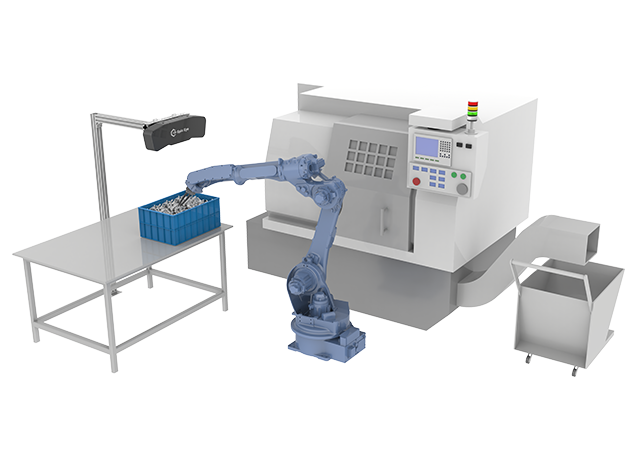
In many automated production lines, part handling remains a frequent source of delay. Tasks such as sorting randomly placed components or feeding machines often require manual intervention, which interrupts workflow continuity. This is where bin picking systems, especially those based on 3D vision, are increasingly applied. Companies like Transfer3D provide solutions designed to help robots recognize and handle disordered parts with improved consistency, making them suitable for addressing specific operational bottlenecks.
Unstructured Part Feeding Challenges
One common bottleneck occurs when parts arrive in bulk without fixed orientation. Traditional automation struggles with such variability, often leading to stoppages or slower cycle times. Robotic bin picking systems address this by using 3D imaging and pose estimation to identify objects in random positions. In practical applications, solutions developed by Transfer3D allow robots to detect complex shapes and surfaces, including reflective or irregular items, reducing the need for manual sorting and stabilizing upstream processes.
Machine Tending and Cycle Time Gaps
Another area where delays appear is machine tending, particularly when loading and unloading parts into CNC machines or assembly stations. Inconsistent part placement can slow down robotic operations or require additional alignment steps. By integrating bin picking with adaptive vision systems, robots can locate and grasp parts directly from containers. This approach, often seen in robotic bin picking deployments, helps maintain a more continuous production rhythm and reduces idle time between machining cycles.
Integration into Flexible Manufacturing Lines
Modern production environments often require flexibility to handle multiple product types. Fixed automation setups may struggle when switching between different components. Here, robotic bin picking provides adaptability, as vision-based systems can be trained to recognize various objects without significant hardware changes. Solutions from Transfer3D demonstrate how combining 3D cameras with configurable software can support such flexibility, allowing manufacturers to adjust workflows without extensive reconfiguration.
Conclusion
Production bottlenecks related to part randomness, machine idle time, and limited flexibility can be effectively addressed with bin picking technologies. By enabling robots to operate in less structured environments, robotic bin picking supports smoother material flow and more consistent cycle times. As shown in implementations associated with Transfer3D, these systems are particularly relevant for manufacturers seeking to improve efficiency in handling tasks without relying on manual intervention.
