Choosing between a robotic welding cell and a fixed welding station for automotive BIW is less about whether robots are “better” than dedicated equipment. The more useful question is how the body structure, weld distribution, model mix, takt target, and process-control strategy interact.
A fixed station may be highly effective for a stable operation, while a robot can be justified when one welding system must accommodate changing access conditions and multiple weld locations.
The Real Decision Starts With How the BIW Is Built
BIW welding is governed by geometry before it is governed by automation. Resistance spot welding requires electrodes to approach the joint from appropriate directions while applying force and current through the sheet stack. Consequently, fixture layout, gun geometry, part presentation, and access must be resolved together.
Research on robotic automotive welding lines shows that accessibility, movement between weld points, and interference between robots can directly affect line balancing. One studied production line involved 42 robots and more than 700 welding points, illustrating why robot deployment cannot be evaluated simply by counting welds per minute.
A useful engineering exercise is therefore to divide weld points into groups according to accessibility and repetition. If a group has stable geometry and a predictable sequence, a dedicated station may be efficient. If points are distributed around a complex body structure, programmable robot movement can provide more routing options.
A Fixed Station Wins When Repetition Is the Production Strategy
Fixed welding stations make particular sense when the manufacturing process itself is intentionally repetitive. Dedicated fixtures can present the same components in a controlled position, while welding equipment follows a defined sequence with limited motion variation.
Such an arrangement can reduce programming complexity and make troubleshooting more localized. Maintenance teams know which tooling, actuator, transformer, and welding head belong to a specific operation. For a high-volume component with limited product variation, that predictability can be valuable.
The limitation appears once the product changes faster than the station architecture. New weld locations, revised panel geometry, or additional variants can require mechanical modification rather than merely changing a robot program. Consequently, the economic comparison should include engineering changes and future tooling work rather than only initial equipment cost.
Robots Become Valuable When the Product Keeps Moving
Automated resistance welding becomes strategically useful when the body moves through multiple operations that require different electrode approaches. A robot can reposition the welding gun across a programmed sequence instead of dedicating a separate mechanism to every location.
That flexibility is not free. Robot reach, gun payload, cable routing, collision avoidance, fixture clearance, and motion time all become engineering variables. A poorly planned robot cell may spend substantial time traveling between weld points, eliminating the apparent productivity advantage.
The strongest case for robotic equipment therefore appears where programmable movement solves a genuine production problem: many weld positions, difficult access, model variation, or the need to rebalance work between stations. Automotive automation research likewise treats robot utilization, fixture flexibility, and weld-point assignment as connected design issues rather than isolated equipment choices.
The Welding Controller Changes the Comparison
A BIW cell should not be evaluated by its robot alone. The welding controller determines how the electrical welding process is executed, while the robot determines where and when the gun reaches the joint. The two systems must work as one process.
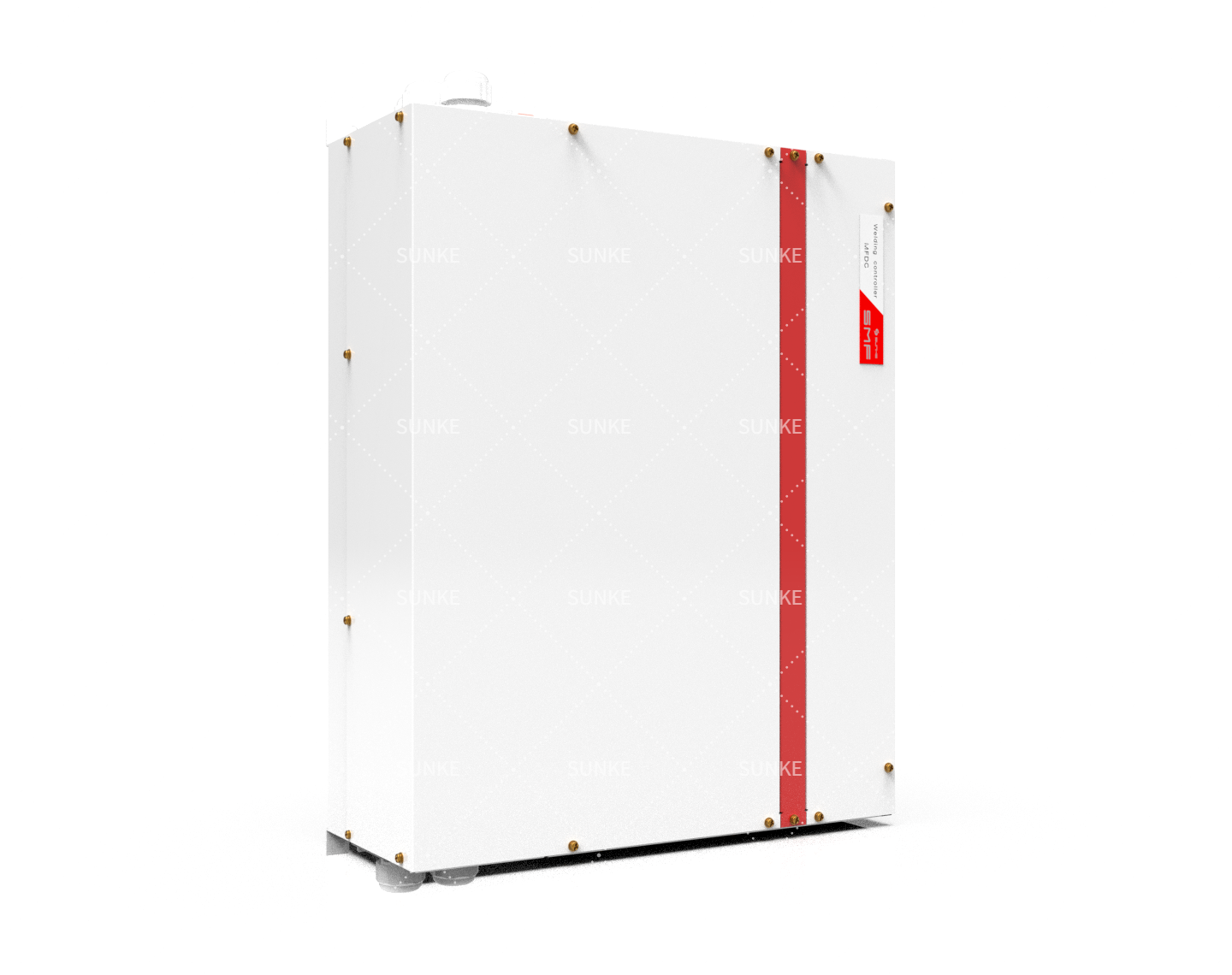
For high-volume production, current regulation, weld schedules, feedback, communication, and diagnostics become important selection criteria. Sunke’s published MFDC controller information, for example, describes primary and secondary current control, secondary feedback, multiple weld schedules, and industrial fieldbus options.
Those functions matter in both robotic and fixture-based systems. Sunke also states that its controllers can integrate with spot, projection, and seam welding equipment and can be configured for standalone or automated systems. This means the controller should be specified according to the welding process and automation architecture, rather than chosen only after the robot or fixture has already been selected.
Takt Time Is a Line Problem, Not a Robot Problem
A common purchasing mistake is comparing nominal welding speed instead of complete station takt. A weld point may require only a short electrical weld cycle, but the station still has to clamp, position, move the gun, complete the programmed sequence, release the workpiece, and communicate with upstream and downstream equipment.
Robotic welding studies confirm that minimizing movement time alone does not necessarily produce the best line balance. Trade-offs can exist between movement, weld-point allocation, and the number of operations assigned to each robot.
For this reason, automotive engineers should model the entire station before deciding. A fixed station with extremely short mechanical travel may outperform a robot for a narrow task. Conversely, several dedicated stations may create a larger system footprint or more complicated tooling strategy than a properly balanced robot cell.
Choose the Supplier That Can Engineer the Whole Welding Architecture
Supplier selection should follow the production problem rather than the equipment category. A manufacturer evaluating resistance welding solutions should ask suppliers to demonstrate how their controller, transformer, welding gun, fixture interface, communication system, and automation equipment will work together.
The same evaluation should cover parameter development, process monitoring, fault diagnosis, spare parts, commissioning, and future model changes. Their controller-selection guidance asks customers to provide material type, thickness, input voltage, welding current and time, production beat, communication requirements, adaptive functions, and cooling requirements.
That level of process information is more useful than asking whether a supplier sells “robotic” or “fixed” equipment. A capable supplier should be able to translate the BIW weld map into a practical equipment architecture and identify where automation adds value and where dedicated tooling is more appropriate.
The final decision is therefore not simply between robotic and fixed welding. For one BIW operation, a fixed station may provide the repeatability and simplicity required by a stable process. For another, automated resistance welding may provide the access and reconfiguration capability needed to manage a more complex production environment.
Sunke offers MFDC and MFAC welding controllers for automated and fixture-based welding configurations, giving integrators another factor to examine: whether the welding-control platform can remain suitable as the production architecture changes.
The better choice is the architecture that meets the required weld access and takt without creating unnecessary complexity. For BIW decision-makers, the strongest purchasing process begins with the body structure and production sequence, then works backward to the robot, fixture, controller, and welding power system. That approach produces a more defensible equipment decision than choosing automation technology first.
