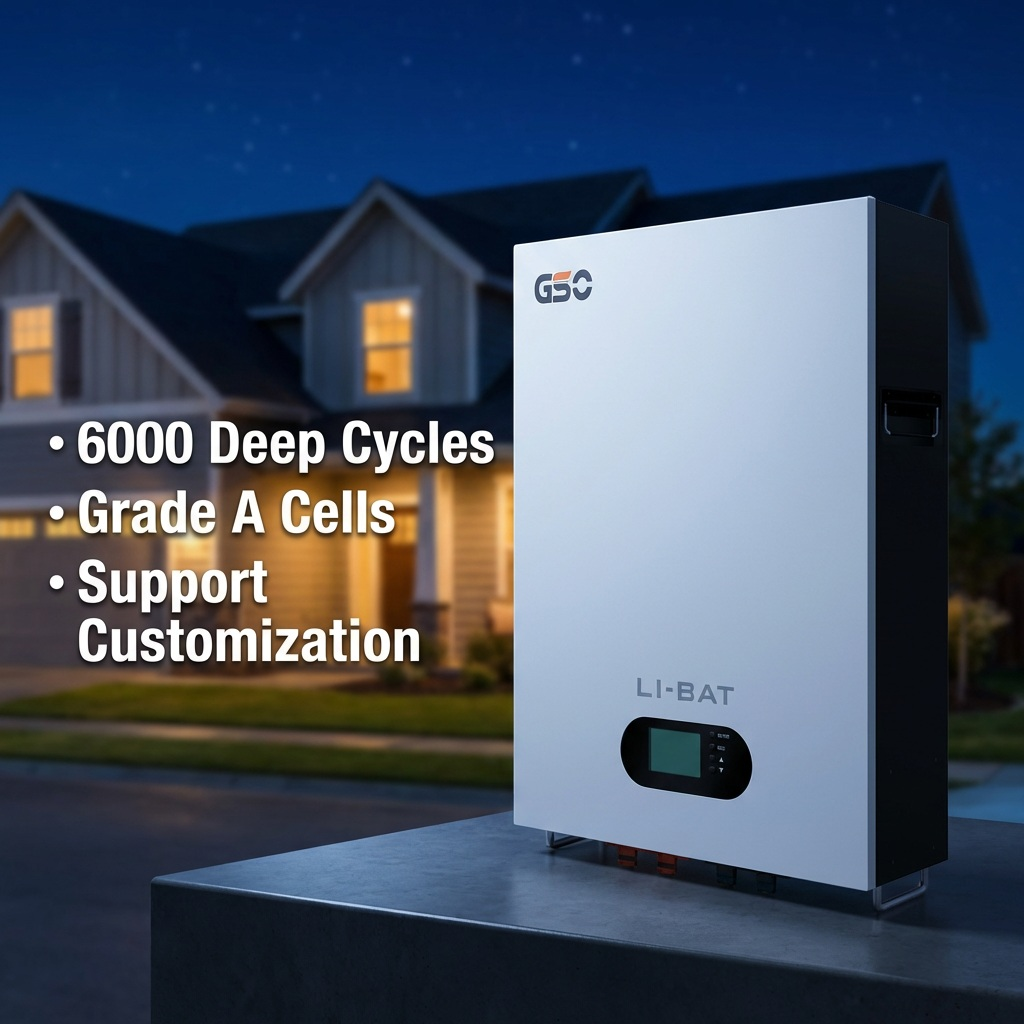
Residential battery selection begins with the household rather than the battery catalogue. Two homes can use similar amounts of electricity over a month yet require very different backup systems because their critical loads, peak demand, installation space, outage expectations, and inverter configurations are not the same.
For a battery backup for home, household requirements translate into electrical and physical criteria. The best solar batteries for home use are those that match the property’s actual energy pattern while leaving a practical path for monitoring, safe installation, and future expansion.
Define What the Battery Must Support
The first task is to identify which loads need stored power and for how long. A household seeking short outage protection for lighting, refrigeration, communications, and office equipment has a different requirement from one expecting to support most circuits for many hours.
GSOpower notes that a typical household may require roughly 10–30 kWh for essential backup, but actual sizing should come from real load demand and desired outage duration. Daily kWh consumption and the portion considered essential during a power interruption provide the sizing basis for a battery backup for home.
Peak power also matters. Energy capacity describes how long loads can operate, while charge and discharge capability affects how much power can be delivered at a given moment. A battery with adequate kWh may still require careful matching if several high-power appliances operate simultaneously.
Separating essential and nonessential loads can also change the required storage size because the same battery lasts longer when fewer circuits remain active. Backup duration is therefore tied to the selected load mix as well as the battery’s nominal energy.
Match Capacity With Available Installation Space
Residential properties impose physical constraints that are easy to overlook during a specification comparison. Mechanical rooms, garages, utility walls, corridors, and other installation areas may limit the dimensions or mounting style that can be used safely.
The GSOpower GBP-W Series is a wall-mounted LiFePO4 battery designed to reduce floor-space requirements. Available versions include 25.6 V, 48 V, and 51.2 V models with 100 Ah or 200 Ah nominal capacity, giving listed nominal energy values from 2.56 kWh to 10.24 kWh depending on configuration.
For the best solar batteries for home applications, this relationship between energy capacity and physical format can be just as important as chemistry. A smaller household may need only one module, while a larger load profile can require multiple units. Automatic addressing handles battery identification as GBP-W units are paralleled, so expansion does not require a separate battery ID to be assigned manually to every added module.
Review Operating Limits, Temperature and Cycling
Battery specifications describe the conditions under which the equipment is expected to operate. The GBP-W range lists operating voltage windows of 22.4–29.2 V, 42–54.75 V, or 44.8–58.4 V depending on model, with corresponding recommended charge voltages of 27.6 V, 51.75 V, and 55.2 V.
Standard charge and discharge rate is 0.5C, while continuous 1C operation can be customized. The listed overall operating-temperature range is -30 to 60°C, with 10 to 35°C recommended for operation and -10 to 55°C specified for charging and discharging. Protection level is IP20, and cooling may use natural air or an intelligent fan depending on configuration.
Suitable installation conditions keep a battery backup for home within these environmental and electrical limits. Cycle life is also relevant to households planning frequent solar-energy shifting rather than rare emergency use. The product family is specified at more than 5,000 cycles at 80% depth of discharge, while GSOpower also lists more than 6,000 cycles and a 10-year life for the series.
Make Inverter Communication Part of the Decision
Residential storage depends on coordination between the battery and the inverter. The LCD on the GBP-W battery provides real-time battery status and includes an on-screen inverter protocol selector. The protocol selector supports multiple inverter communication profiles for system integration.
This communication capability is directly relevant to the best solar batteries for home because incompatible protocols can restrict system integration even if voltage and capacity look suitable on paper. Inverter support therefore belongs in the storage decision before installation rather than being treated as a secondary communication detail.
The wall-mounted design also illustrates how product selection can combine electrical and practical needs. GSOpower positions the GBP-W Series for residential storage where floor-space savings, status visibility, inverter compatibility, and parallel expansion are important. Those characteristics are useful only when they correspond to the property’s actual requirements.
A household battery is not “best” simply because it offers the highest capacity or the longest specification list. The correct choice starts with essential loads, outage duration, available space, inverter platform, expected cycling frequency, charge and discharge requirements, and installation environment. From there, capacity and expansion can be matched to the property rather than selected in isolation.
For residential backup, the relevant test is whether a battery backup for home can support essential loads without unnecessary oversizing. The best solar batteries for home are those whose electrical limits, communication, placement, and long-term operating profile remain compatible with the residence as a whole.
