Artificial intelligence is changing the electrical profile of modern data centers. As GPU clusters become denser, facilities must manage not only higher power consumption but also faster load changes, harmonic distortion, reactive power, and increasingly demanding grid-interconnection requirements. IEEE has noted that AI-driven data center growth is creating new challenges for power and energy infrastructure, particularly as large concentrated loads place greater pressure on existing systems.
For data center owners, EPC contractors, facility managers, and electrical engineers, power quality can no longer be treated as a secondary consideration. The design of the power distribution system must account for the characteristics of modern server PSUs, UPS equipment, PDUs, and high-density GPU racks from the planning stage.
Why AI GPU Racks Are Changing the Electrical Load Profile
Traditional data center loads were often comparatively predictable. AI computing introduces a different operating pattern. GPU clusters can create rapid and synchronized changes in electrical demand, with high-density AI racks increasingly requiring substantially more power than conventional IT racks. IEEE research and industry discussions have highlighted the millisecond-scale load variations and grid-interface challenges associated with large AI computing facilities.
This creates a more demanding environment for transformers, UPS systems, switchgear, generators, and power distribution equipment. A system designed around average load alone may not adequately address rapid changes or the resulting power-quality effects.
What Is the Biggest Problem for Data Centers?
What is the biggest problem for data centers? There is no single electrical problem that applies to every facility, but power quality is becoming one of the most important challenges as data centers scale. Harmonic currents, voltage disturbances, reactive power, rapid load changes, and increasing grid-interconnection requirements can interact across the electrical system.
The challenge becomes particularly significant when hundreds or thousands of non-linear electronic loads operate simultaneously. Server power supplies and UPS rectifiers can draw distorted current, while the aggregate effect can increase stress on transformers and upstream electrical equipment.
IEEE’s recent work on data center deployment also identifies power quality, ride-through performance, monitoring, protection coordination, and grid interaction as important considerations as data center requirements evolve.
What Are Harmonics in Data Centers?
What are harmonics in data centers? Harmonics in data centers are unwanted frequency components of electrical current or voltage that occur alongside the fundamental frequency. They are commonly associated with non-linear electronic equipment, including power electronic converters and server power supplies.
The practical issue is cumulative impact. A single server may have limited influence, but a large data hall containing many electronic loads can create a substantial harmonic current burden. Harmonics can contribute to additional heating and losses in transformers, cables, and other electrical equipment, making power-quality monitoring important for high-density facilities.
Enjoypowers identifies 3rd, 5th, and 7th harmonics as significant components associated with modern server PSU loads and recommends active filtering at appropriate distribution points to address aggregated distortion.
Why Fast Power Quality Compensation Matters
AI workloads can make electrical demand more dynamic, increasing the importance of fast-responding power-quality equipment. Conventional approaches may not always provide the flexibility required when loads change rapidly or when harmonic profiles vary between operating conditions.
Enjoypowers’ data center power quality solution is designed around a stated 5 ms response time, with a stated target of THDi below 5%. The company’s SinL Pro Series uses a silicon-carbide platform and offers AHF capacities from 30 A to 200 A, while SVG modules range from 20 kVar to 150 kVar.
The SinL Pro platform also covers the 2nd through 50th harmonic orders, with a stated filtering rate of at least 95% at rated load and output current distortion of no more than 5%. These specifications make the platform relevant to engineers evaluating active harmonic filtering for dense electronic loads.
Where Active Filtering Fits Into a Data Center
Power-quality equipment can be deployed at different electrical levels depending on facility architecture. At the PDU level, active harmonic filtering and reactive compensation can target a particular data hall or rack row. This approach can be useful for phased expansion or facilities containing different tenant and equipment profiles.
At the facility level, larger systems can address aggregated electrical conditions at the main bus or utility intake. Enjoypowers describes both approaches for data center applications, allowing system designers to consider the location of harmonic sources and the required compensation capacity.
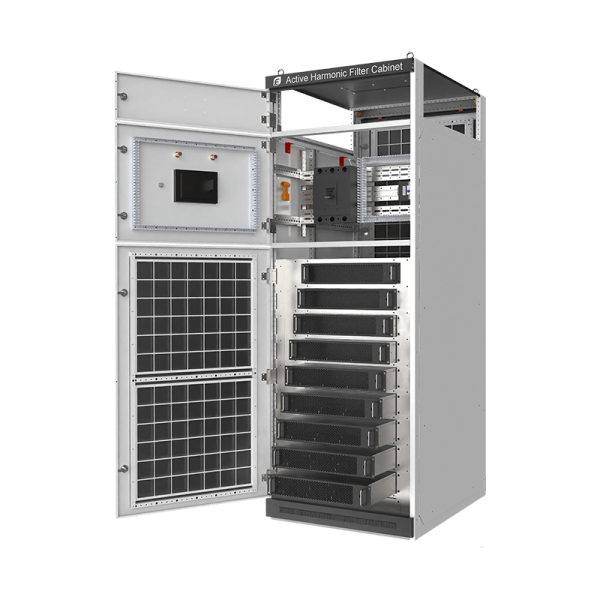
Redundancy is another consideration for mission-critical facilities. Enjoypowers supports N+1 configurations for its data center power-quality installations. Its SinL Pro Cabinet can accommodate up to 12 modules, with 11 operating modules capable of providing the rated capacity while another module serves as redundancy.
Designing for the Next Generation of AI Infrastructure
Power-quality planning should begin with measurements rather than assumptions. Engineers can examine interval load data, harmonic spectra, power factor, voltage conditions, and the behavior of UPS and PDU equipment before determining the appropriate compensation architecture.
This approach becomes increasingly valuable as AI facilities expand. IEEE is already examining standards and technical requirements covering data center interconnection, power quality, ride-through capabilities, monitoring, and system studies.
Enjoypowers positions its power-quality portfolio around active harmonic filtering and reactive power compensation for data centers, colocation facilities, and edge infrastructure. Its stated design targets include 5 ms response, THDi below 5%, and N+1 redundancy, giving professional buyers concrete parameters to consider during preliminary system evaluation.
Power Quality Becomes an AI Infrastructure Requirement
AI and GPU computing are pushing data centers toward higher rack densities, faster load changes, and more complex electrical behavior. As a result, power quality must increasingly be considered alongside capacity, redundancy, cooling, and uptime during facility design.
For data center developers and electrical-system integrators, the key is to understand the actual load profile and its harmonic characteristics before selecting mitigation equipment. Solutions such as Enjoypowers‘ active harmonic filters and static var generators demonstrate how fast-response compensation, measurable THDi targets, and modular redundancy can be incorporated into modern data center power architectures.
