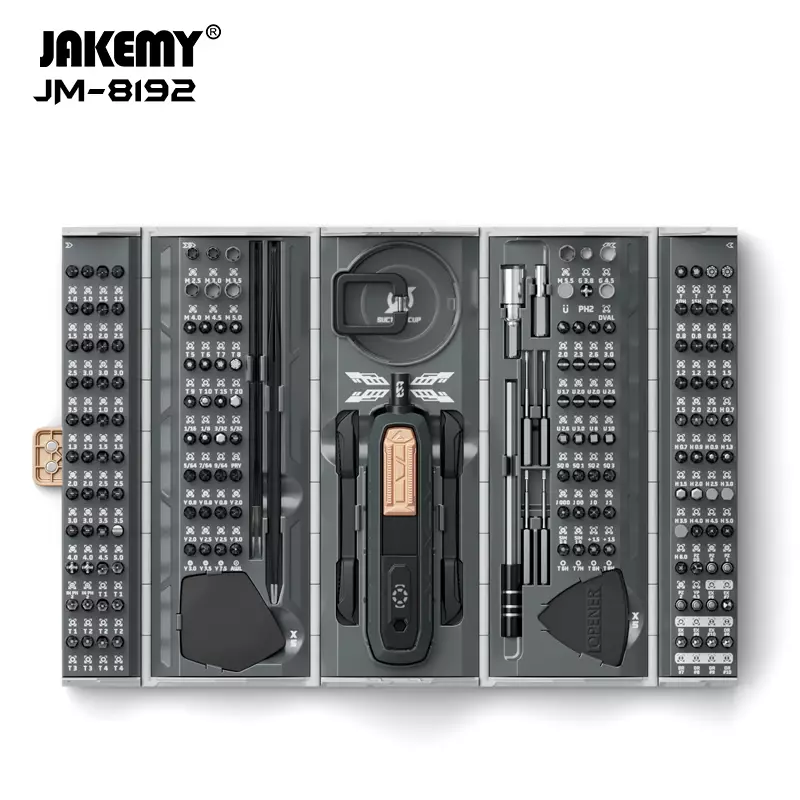
Selecting professional precision tooling requires evaluating how mechanical tolerances and alloy compositions perform under repetitive workshop use. Modern consumer electronics rely on miniaturized fasteners that strip easily when driven with improper bit profiles. Repair technicians face significant productivity losses whenever substandard steel yields under torque, rounding screw recesses and damaging delicate chassis components.
Device disassembly demands comprehensive toolkits capable of servicing smartphones, laptops, cameras, and wearable devices without requiring supplementary hardware. Successful procurement strategies focus on six structural factors: metallurgy, bit variety, handle ergonomics, auxiliary opening tools, workstation footprint, and supply chain flexibility. Evaluating these technical attributes guarantees high repair throughput and protects sensitive electronic assemblies during daily maintenance operations.
Metallurgy and Protective Surface Treatments
Metallurgy dictates how effectively driver bits withstand shear stresses across hundreds of fastening cycles. Premium precision kits utilize chrome vanadium (CR-V) tool steel hardened to resist tip deformation on standard fasteners. For deeper recesses and high-wear applications, specialized S2 alloy steel provides elevated tensile resilience, preventing brittle fractures when technicians loosen factory-torqued internal screws.
Tool configurations like the Jakemy 180 in 1 apply chemical zinc phosphate treatments to driver bits to inhibit oxidation from workshop humidity and skin contact. This phosphating process creates a tough surface barrier that minimizes micro-abrasions without introducing dimensional instability. Surface-treated alloy bits seat cleanly inside fastener recesses, ensuring maximum rotational engagement while eliminating cam-out risks on microscopic threads.
Bit Architecture and Extraction Tooling Variety
Screwdriver selections must address the vast proliferation of proprietary fasteners across modern consumer electronics. Technicians frequently encounter Torx, security Torx, Pentalobe, tri-wing, triangle, standoff, and JIS drive profiles within a single device generation. A comprehensive toolkit must supply standard drive geometries alongside miniature sockets ranging from M2.5 to M5.5 for securing motherboard retaining standoffs.
Engineering benchmarks such as the Jakemy JM-8192 incorporate 144 CR-V bits alongside specialized S2 steel components to satisfy varied fastening demands. Beyond standard drivers, modern repair environments require dedicated extraction tooling to remediate stripped threads. Bundling reverse screwdriver bits (EX#6 through EX#10) and miniature hole saws (DR#6 through DR#10) allows technicians to extract damaged fasteners without harming circuit boards.
Handle Ergonomics and Magnetic Damping Control
Hand fatigue directly degrades fastening precision during extended electronic repair sessions. Ergonomic driver handles require textured, slip-resistant grips that facilitate fingertip control without demanding excessive clamping pressure. An integrated swivel cap allows technicians to maintain continuous downward alignment while rotating the driver shaft smoothly, preventing bit slippage inside microscopic screw heads.
Adjustable driver assemblies such as the Jakemy JM-8192 feature internal magnets producing tactile resistance along a movable push slider. This magnetic damping mechanism enables operators to customize handle length to suit varying palm dimensions. Balanced weight distribution combined with magnetic bit seating ensures accurate torque transmission across delicate camera mounts and logic boards.
Anti-Static Disassembly and Non-Marring Accessories
Complete electronics servicing extends well beyond threaded fasteners to include housing separation and ribbon cable manipulation. Technicians routinely navigate tight snap-fit enclosures, fragile display adhesives, and delicate micro-coaxial connectors. High-caliber toolkits integrate dedicated opening accessories directly into the primary kit, eliminating the need to source mismatched auxiliary tools during active device disassembly.
Bundled accessories inside the Jakemy 180 in 1 feature dedicated ESD tweezers and ultra-thin opening tools to avoid electrostatic hazards. Anti-static curved and straight tweezers allow safe placement of conductive components around integrated circuits. Supplementing these with flexible extension shafts, suction cups, and resilient spudgers ensures technicians pry glass panels and release battery packs without gouging cosmetic bezels.
Compact Bench Organization and Magnetic Retention
Workstation clutter poses a persistent operational hazard in high-volume repair facilities. Lost driver bits interrupt repair workflows and increase the risk of stray metal particles contacting exposed circuit assemblies. Precision kits require structured storage enclosures that keep dozens of miniature bits organized, labeled, and instantly accessible on crowded work surfaces.
Housing hundreds of components within a compact 193*85*85 millimeter profile optimizes workbench real estate. Utilizing a mini toolbox container with an interactive magnetic box plate keeps bits firmly anchored against accidental drops. Technicians can rapidly deploy, re-index, and secure driver bits during component swaps, preserving bench cleanliness and accelerating turnaround times across multiple repair queues.
Manufacturing Compliance and Procurement Scalability
Enterprise buyers and distributors require tool partnerships that satisfy rigorous quality standards and commercial purchasing flexibility. Sourcing hand tools without international conformity marks exposes commercial operations to regulatory liabilities and inconsistent manufacturing batches. Verifying product conformity, such as CE certification, confirms that materials and construction methods adhere to recognized industrial safety norms.
Procurement teams sourcing the Jakemy JM-8192 benefit from verified CE compliance and an accessible baseline MOQ of 100 units. Flexible minimum order thresholds allow regional repair chains and hardware resellers to test market demand before committing capital to full container shipments. Source-factory backing with OEM and ODM customization options further empowers brands to implement custom private labeling and localized packaging.
Final Sourcing Assessment for Precision Electronics Toolkits
Establishing an efficient electronics repair workflow depends on selecting precision toolsets engineered for mechanical endurance, fastener breadth, and operator ergonomics. Evaluating metallurgy, bit varieties, anti-static accessories, and modular case designs prevents costly workbench downtime. Toolkits that combine tough CR-V and S2 alloys with specialized extraction bits ensure repair staff handle both routine maintenance and damaged fasteners successfully.
Investing in a standardized workstation system like the Jakemy 180 in 1 simplifies technician onboarding while maintaining strict disassembly tolerances. Sourcing certified precision hardware backed by flexible supply chain terms provides workshop managers with consistent operational reliability. Prioritizing these six fundamental factors ensures every repair station remains fully equipped to service contemporary and next-generation electronic devices with confidence.
