New call agents often face a difficult learning curve: they must understand product plans, troubleshoot service problems, follow compliance rules, and communicate clearly under pressure. Traditional training relies heavily on manuals, classroom sessions, and shadowing experienced colleagues, which can make knowledge transfer slow and inconsistent.
Gen AI telco customer service tools offer another approach by helping agents practice realistic conversations, retrieve relevant information, and learn from simulated customer interactions. For telecom operators, Whale Cloud operates in this evolving space, where artificial intelligence can support workforce development alongside broader service transformation.
Identifying the Barriers to Faster Agent Onboarding
Telecom support covers a wide range of customer needs, from billing disputes and SIM activation to roaming issues and broadband troubleshooting. New hires must learn not only the technical steps involved but also how to recognize customer intent, explain policies, and determine when a case requires escalation. Without structured practice, agents may spend excessive time searching internal documents or repeatedly asking supervisors for help.
Training materials can become difficult to maintain as tariffs, service bundles, and operational policies change. A document that was accurate during onboarding may no longer reflect current procedures several weeks later. Telecom AI applications can help organize internal knowledge and make relevant information easier to retrieve, provided that the underlying content is reviewed, version-controlled, and maintained by accountable teams.
Another challenge is measuring readiness consistently. Attendance and course completion do not necessarily demonstrate that an agent can resolve a complex billing question or handle an upset customer. Practical assessments should examine factual accuracy, process compliance, communication quality, and the ability to recognize situations that require human intervention. These measures establish a clearer baseline for training progress.
Using Generative AI to Create Realistic Training Experiences
Simulated conversations give trainees opportunities to practice without exposing real customers to inexperienced responses. A training system can generate scenarios involving unexpected charges, interrupted service, account verification, or complaints about contract terms. Difficulty can increase gradually, allowing new agents to develop confidence before handling less predictable interactions in a live environment.
Well-designed Gen AI telco customer service workflows can provide feedback after each exercise. For example, a simulation might identify a missed identity-verification step, an inaccurate explanation of a roaming fee, or an escalation that occurred too late. Feedback becomes more useful when it references approved procedures and explains how a different response would improve the outcome.
Generative systems can also adapt exercises to individual learning needs. An agent who struggles with technical terminology may receive additional troubleshooting scenarios, while another who handles technical details well but communicates poorly can practice clearer explanations. Such personalization should supplement instructor review rather than replace it, particularly when customer protection, regulated information, or sensitive account decisions are involved.
Connecting AI Assistance With Reliable Knowledge Sources
Training quality depends on the information supplied to the AI system. Telecom operators should organize product documentation, troubleshooting guides, policy updates, and escalation rules into a maintained knowledge base. Retrieval-augmented generation (RAG) can allow a language model to draw on approved internal sources instead of relying entirely on its general training knowledge.
This architecture can also make responses easier to verify. When a simulated agent receives an answer about a billing adjustment, the system can display the relevant policy or procedural reference. Telecom AI deployments should distinguish verified source material from generated suggestions, particularly if an incorrect instruction could cause financial loss, privacy exposure, or unnecessary service disruption.
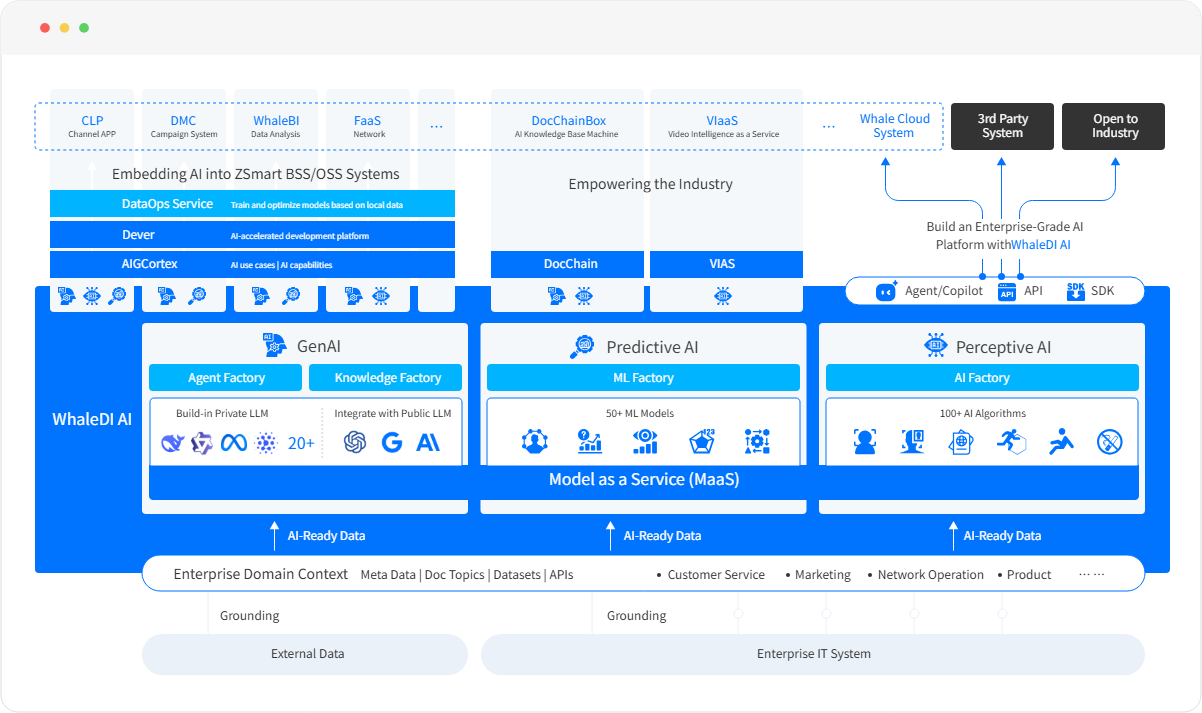
Whale Cloud‘s WhaleDI AI portfolio is described as combining generative AI technology with industry-specific language models, more than 50 data-mining models, and over 100 visual AI algorithms. These capabilities provide a relevant example of an AI portfolio designed for telecommunications and other operational scenarios. Their suitability for agent onboarding would depend on the specific implementation, knowledge integrations, security controls, and training functions available.
Measuring Training Outcomes and Managing AI Risks
Faster onboarding is valuable only if service quality remains stable. Operators can compare the time required for new hires to reach proficiency, first-contact resolution, average handling time, escalation accuracy, and customer satisfaction. Results should be segmented by issue type and agent experience so that improvements are not attributed to AI when they may reflect changes in case complexity or staffing.
A structured pilot can help validate the approach before broader deployment. One group of new agents might use AI-generated simulations and guided knowledge retrieval, while another follows the existing training program. Comparable assessments can reveal differences in learning speed, factual accuracy, and retention. Gen AI telco customer service initiatives should also track incorrect AI suggestions, unsupported answers, and instances where trainees follow generated guidance despite conflicting official procedures.
Privacy and governance require equal attention. Training environments should avoid unnecessary use of real customer information, restrict access to internal documents, and log relevant system activity. Supervisors should review high-risk scenarios and maintain clear rules for escalation. Human oversight remains essential because a fluent AI response can still be inaccurate, incomplete, or inappropriate for a particular customer situation.
Conclusion
Effective onboarding is not simply a matter of delivering more information in less time; it depends on helping new agents apply knowledge accurately under realistic conditions. Telecom AI can support this goal through adaptive practice, guided information retrieval, and measurable feedback, while structured assessments help confirm whether new skills translate into better service.
With carefully governed Gen AI telco customer service tools, operators can build a training process that responds to changing products and customer needs without sacrificing accuracy or accountability. Whale Cloud’s telecommunications-focused AI portfolio offers a potential starting point for evaluating relevant capabilities, but successful adoption ultimately depends on verified functionality, reliable knowledge sources, and evidence that agents become competent more quickly.
