Before a new molecule is given to a human for the first time, its pharmacokinetic behavior has to be characterized in more than one animal species. This is not a regulatory formality — it is the foundation for the calculation that determines the starting dose in a Phase I trial, and getting that calculation wrong in either direction carries real consequences, from an underpowered dose-finding study to an unnecessary safety risk.
Why Preclinical PK Testing Relies on More Than One Species
Different animal species metabolize compounds at different rates, largely as a function of body size and metabolic rate rather than body weight alone. Because of this, preclinical pharmacokinetic testing typically includes both a rodent species, usually rats, and a non-rodent species, usually dogs, so that a sponsor can compare how a compound behaves across biologically distinct systems rather than relying on a single species that might not represent human physiology well.
This multi-species approach also serves a specific safety purpose: regulatory guidance generally directs sponsors to identify whichever species shows toxicity at the lowest dose, referred to as the most sensitive species, and to base the human starting dose calculation on that species’ data rather than defaulting to whichever species happens to be more convenient or more commonly used.
Where Preclinical Infrastructure Supports This Testing
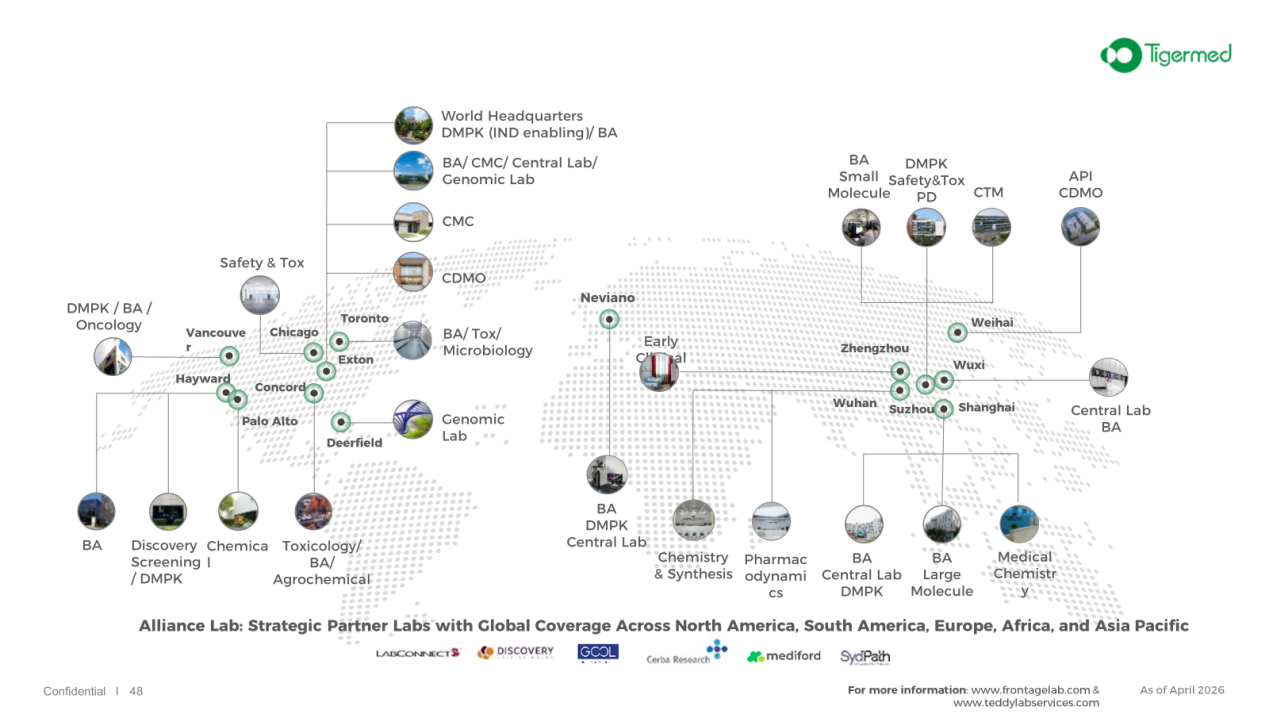
Generating reliable multi-species PK data depends on laboratory infrastructure capable of running both in vitro screening and in vivo studies to consistent standards across sites. Tigermed’s preclinical research services group operates laboratories across the US, China, and Europe, reporting more than 120,000 square meters of lab space and a track record of successful regulatory inspections from the FDA, China’s NMPA, the WHO, and the US EPA, alongside AAALAC-accredited animal facilities.
Within this infrastructure, Tigermed’s DMPK service line covers in vitro plasma protein binding screening, metabolic stability testing, transporter studies, metabolic enzyme studies, and metabolic soft-spot analysis, in addition to in vivo pharmacokinetic screening. These in vitro assays generally run in parallel with in vivo work, since early ADME data helps flag potential species differences in metabolism before a sponsor commits to a full in vivo PK study design.
Allometric Scaling: Converting Animal Doses to Human Equivalents
Once a no-observed-adverse-effect-level (NOAEL) has been established in the most sensitive species, that dose has to be converted into a human equivalent dose (HED). FDA’s 2005 guidance on estimating the maximum safe starting dose recommends doing this through body surface area normalization rather than simple body-weight scaling, since metabolic rate correlates more closely with surface area than with weight alone across species of different sizes.
In practice, this involves dividing the animal NOAEL, expressed in mg/kg, by a standard conversion factor specific to that species — commonly around 6.2 for rats and 1.8 for dogs, according to the FDA’s published methodology — to arrive at the HED in mg/kg for a human. A default safety factor of 10 is then generally applied to the HED to calculate the maximum recommended starting dose (MRSD), though sponsors may apply a larger safety factor when a compound’s characteristics warrant additional caution, such as a steep dose-response curve or a novel mechanism of action.
From HED to a Defensible Starting Dose
The MRSD calculated through this process represents a ceiling, not necessarily the dose a sponsor actually selects for a first-in-human study. Sponsors often set the actual proposed starting dose below the MRSD, informed by predicted human pharmacokinetic exposure relative to the exposure margins observed at the NOAEL, and by how the anticipated pharmacologically active dose compares to the calculated maximum.
For high-risk biologics, particularly those with strong agonist activity on the immune system, regulatory guidance also recognizes an alternative approach known as the minimum anticipated biological effect level (MABEL), which can result in a more conservative starting dose than the NOAEL-based calculation alone would suggest. Sponsors developing this kind of molecule are generally advised to evaluate both approaches and select the more conservative of the two, since the NOAEL-based method was originally developed with small-molecule pharmacology in mind rather than biologics with the potential for significant immune activation at low doses.
Applying Multi-Species PK Data to Phase I Design
The value of thorough preclinical PK testing extends beyond the initial starting-dose calculation. Data on absorption, distribution, metabolism, and elimination across species also informs the predicted human half-life, which shapes decisions about Phase I dosing frequency, sampling timepoints, and the interval required between dose cohorts in a dose-escalation design. Sponsors evaluating preclinical pharmacokinetics testing services for this purpose generally look for a provider that can generate both the toxicokinetic exposure data needed to support the starting-dose calculation and the broader ADME profile needed to inform sampling and escalation strategy for the trial as a whole.
This is also where preclinical PK data begins to intersect with pharmacodynamic modeling. Combining predicted human exposure with any available pharmacodynamic signal from preclinical pharmacology studies allows a sponsor to build an early PK/PD model, which can help anticipate where a pharmacologically active exposure range is likely to fall relative to the calculated safety margins, informing how quickly a dose-escalation scheme can move between cohorts.
Connecting Preclinical Data to a Well-Supported Phase I Protocol
None of these steps function well in isolation. A NOAEL from a single species without a comparator species offers limited confidence in identifying the truly most sensitive system, and an HED calculation without corresponding ADME and ideally pharmacodynamic data leaves a Phase I team with a starting dose but limited insight into how quickly escalation can proceed. Sponsors are generally advised to plan multi-species PK testing, allometric scaling, and early PK/PD modeling as a connected workstream rather than as sequential, disconnected deliverables.
Companies such as Tigermed, which report DMPK capabilities spanning in vitro screening through in vivo pharmacokinetic studies across an internationally distributed lab network, illustrate one way this connected preclinical PK workstream can be organized under a single provider. As with any preclinical program, sponsors are advised to confirm a partner’s specific experience with their compound class and intended first-in-human dosing approach before finalizing a study design.
