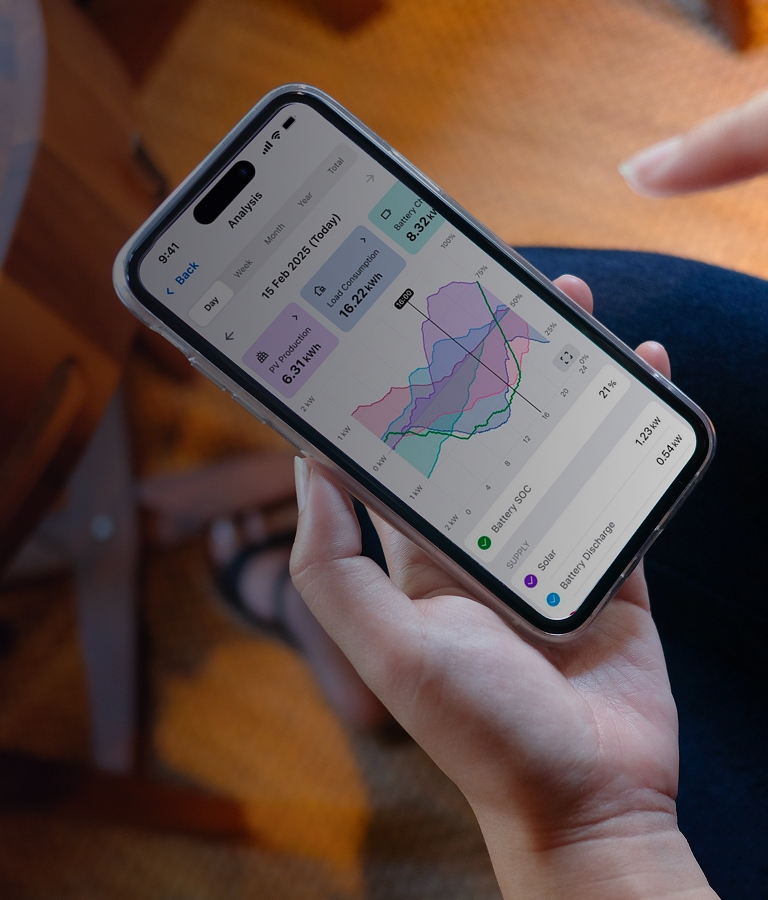
A residential solar-and-storage system can generate and store electricity, but hardware alone cannot provide a complete picture of how energy should be used. Solar production changes throughout the day, household demand fluctuates, batteries have limited capacity, and electricity prices may vary by time. Energy management software connects those variables, giving homeowners and professionals a digital layer for monitoring, control, and optimization.
Monitoring Creates the Foundation for Smarter Energy Decisions
Intelligent energy management starts with visibility. Homeowners need to know how much electricity their solar system is producing, how much the property is consuming, and what the battery is doing at different points during the day.
FoxCloud 2.0 provides this visibility through a centralized interface for energy production and consumption. Its official product information describes monitoring and control functions covering home energy use, smart devices, and energy data across daily, weekly, monthly, and yearly periods.
Historical information adds context that a single live reading cannot provide. A homeowner can identify recurring consumption patterns, while an installer can gain a clearer picture of how an installed system behaves over time.
That distinction matters because smart energy management is not simply about displaying more data. Information becomes valuable when it can support decisions about generation, storage, consumption, and grid interaction.
Energy Data Becomes Useful When Software Can Act on It
A basic monitoring application answers questions such as how much energy a home produced yesterday. A more capable energy management software platform goes further by connecting information with system controls.
FoxCloud 2.0 is designed to combine monitoring with management. According to its product information, users can monitor energy production and consumption while controlling connected home energy equipment through the platform.
That creates a digital connection between the homeowner and the physical energy system. Instead of checking several devices separately, users can interact with information through a common platform.
Such centralization becomes increasingly useful as residential systems grow more complex. Solar inverters, batteries, EV chargers, heat pumps, and other electrified equipment can each generate operating information. A unified interface can make that growing data set easier to interpret.
The broader value lies in coordination. Software can provide the visibility required to understand what the system is doing while creating a pathway for users or automated functions to influence how connected equipment operates.
Dynamic Pricing Adds a Financial Dimension
Energy management becomes more sophisticated when electricity prices are included in the decision-making process. A battery’s value is not determined solely by how much energy it can store. The timing of charging, discharging, solar production, and grid consumption can also matter where electricity prices vary throughout the day.
FoxCloud 2.0 incorporates dynamic tariff functionality. Its product documentation states that users can select Smart Tariff options or create manual tariff plans, with support for up to 96 tariff time slots and multiple tariff providers.
Such functionality allows the software to consider electricity pricing as part of energy management rather than treating every hour as economically equivalent. For homeowners comparing options, tariff-aware control is a key feature that distinguishes a truly best energy management software platform from basic monitoring apps.
A home with appropriately sized storage can use this functionality to shift battery charging and discharging across different pricing periods. Software functionality should not be interpreted as a guarantee of specific savings, as actual financial outcomes depend on local tariffs, household consumption, solar production, battery configuration, and other operating conditions.
Nevertheless, tariff-aware management represents an important step beyond conventional monitoring. The platform can connect technical system information with an economic variable that directly affects household energy decisions.
AI Brings More Adaptive Energy Management
Artificial intelligence adds another dimension by helping software interpret multiple inputs rather than relying entirely on manually configured schedules.
FoxCloud 2.0’s AI MODE is described by the manufacturer as analyzing energy habits, photovoltaic output forecasts, and dynamic or time-of-use electricity pricing to support system optimization.
The platform also provides an AI interaction function that can respond to energy questions and accept certain setting commands through natural-language interaction.
The importance of this capability is not the label “AI” itself. Its value comes from how multiple sources of information can be considered together. Energy consumption patterns, expected solar production, and electricity prices can all influence how a storage system should be managed.
Fox ESS presented FoxCloud 2.0 as part of an integrated energy ecosystem at The Smarter E Europe 2026, highlighting digital optimization alongside residential and broader energy technologies.
Intelligent automation can lessen homeowners’ reliance on human decision-making. Users can set up supported software functionalities to react to changing inputs based on their defined operating strategy instead of constantly reviewing system conditions.
Smart Software Has to Work Beyond the Homeowner App
Residential energy management also involves the professionals who install and maintain systems. An effective digital platform therefore needs to address more than the end user’s smartphone experience.
FoxCloud 2.0 includes web-based management functions for installers and distributors, providing tools for monitoring and managing multiple plants. The platform presents operational information and production trends that can help professional users oversee connected solar and storage installations.
That creates a second level of value. Homeowners can focus on their own energy consumption, while installers and distributors can manage a larger portfolio of systems through professional interfaces.
This lifetime view is crucial for energy management software, especially. After commissioning, residential storage remains a technological asset. The system’s digital connectivity is a continuing component due to the fact that monitoring, maintenance, configuration, and operational evaluation might go on for years.
What Makes Energy Management Software Truly Useful
The strongest platforms are not defined by the number of graphs or menus they contain. Their usefulness comes from connecting meaningful information with practical decisions.
Fox ESS positions FoxCloud 2.0 around that connection, combining monitoring, device management, tariff functionality, AI-assisted energy optimization, and professional system oversight. Its role is therefore broader than a conventional monitoring application.
When homeowners are looking for the finest energy management software, they should consider if the platform can centralise all of the necessary equipment, give data that is easy to grasp, adapt to changing energy circumstances, and provide controls that align with their goals.
Smart residential energy ultimately depends on coordination. Solar panels generate electricity, batteries shift energy through time, household devices create demand, and electricity markets introduce changing costs.
Software provides the layer that can connect those variables. When monitoring develops into tariff-aware management and AI-assisted optimization, residential storage becomes not merely a place to keep electricity, but a more responsive component of the home’s overall energy strategy.
