Automated production lines depend on accurate identification, timely data collection, and stable communication between equipment. When materials move between workstations, production teams need reliable ways to track components, monitor work-in-progress, and record movement without slowing down operations. Manual scanning can create delays when items pass through multiple processes or move across large production areas.
Radio frequency identification (RFID) offers another approach. It allows compatible tags to communicate with readers without requiring direct visual contact. However, successful integration depends on more than installing hardware. Manufacturers must consider tag selection, reading distance, communication protocols, equipment layout, and software compatibility before adding RFID to an existing production system.
Define the Production Requirements First
Before selecting RFID Readers, manufacturers should identify which production activities require automatic identification. Typical applications include tracking components between assembly stations, monitoring material transfers, managing reusable containers, and recording the movement of tools or equipment. Each application has different identification and data collection requirements.
The production team should map the material flow from receiving to assembly and final inspection. This helps identify where tag information must be captured and which events need to trigger a system update. A reader installed at the wrong location may collect irrelevant data or miss important transitions.
Reading distance also deserves careful consideration. A compact workstation may need identification across a short distance, while a large production area may require broader coverage. The selected range should match the movement path and tag characteristics rather than simply aiming for the maximum available distance.
Match Reader Placement to Material Movement
Reader placement determines when and where tag information becomes available. In automated lines, equipment frames, metal surfaces, moving machinery, and nearby radio devices may affect signal propagation. Engineers should assess these conditions before fixing the hardware in place.
For example, a reader near a conveyor transfer point can capture tagged containers as they enter a new production zone. Another installation may monitor equipment moving between indoor and outdoor work areas. The layout should provide a clear identification zone while limiting unnecessary reads from adjacent processes.
Mounting height, antenna orientation, tag position, and the distance between readers all influence performance. Testing should cover normal operating conditions, including changes in conveyor speed and the presence of multiple tagged objects. These checks help engineers determine whether the planned installation can support the required workflow.
Configure Communication and Data Exchange
Hardware integration is only one part of the project. The reader must also exchange data with the production control system, manufacturing execution system (MES), warehouse management system (WMS), or another application responsible for tracking materials.
Communication interfaces should match the available industrial infrastructure. Ethernet may support network-based data exchange, while serial interfaces can connect with compatible controllers or local equipment. Engineers should confirm interface compatibility, data formats, addressing methods, and connection settings before commissioning.
Data handling also needs a clear structure. A tag identifier may need to be associated with a component number, production order, workstation, or process status. The software should define how duplicate reads are handled and how repeated identification events are converted into useful production records. For more guidance on connecting RFID hardware, middleware, and industrial business systems, see RSTC’s industrial IoT solutions with RFID tracking systems guide.
Test Identification Accuracy Under Real Conditions
Laboratory tests provide a useful starting point, but actual production environments introduce additional variables. Metal components, moving machinery, overlapping tags, and nearby radio-frequency sources can influence identification results. Testing should therefore take place in the intended installation area whenever possible.
During a pilot, engineers can record missed reads, duplicate events, processing delays, and identification consistency. They should test different tag orientations and object speeds. These observations help identify whether adjustments to reader placement, tag selection, or software filtering are needed.
A practical acceptance test should use measurable criteria. For example, the team can define the required identification rate, acceptable response time, and data delivery behavior for a specific workstation. Documenting these results creates a reference for future maintenance and system expansion.
Consider Long-Range Identification for Wider Areas
Some production applications extend beyond a single workstation. Large facilities may need to monitor tagged assets, moving goods, personnel, or transport equipment across broad indoor and outdoor areas. In these cases, industrial RFID readers with adjustable reading distances can support identification without requiring operators to scan every item manually.
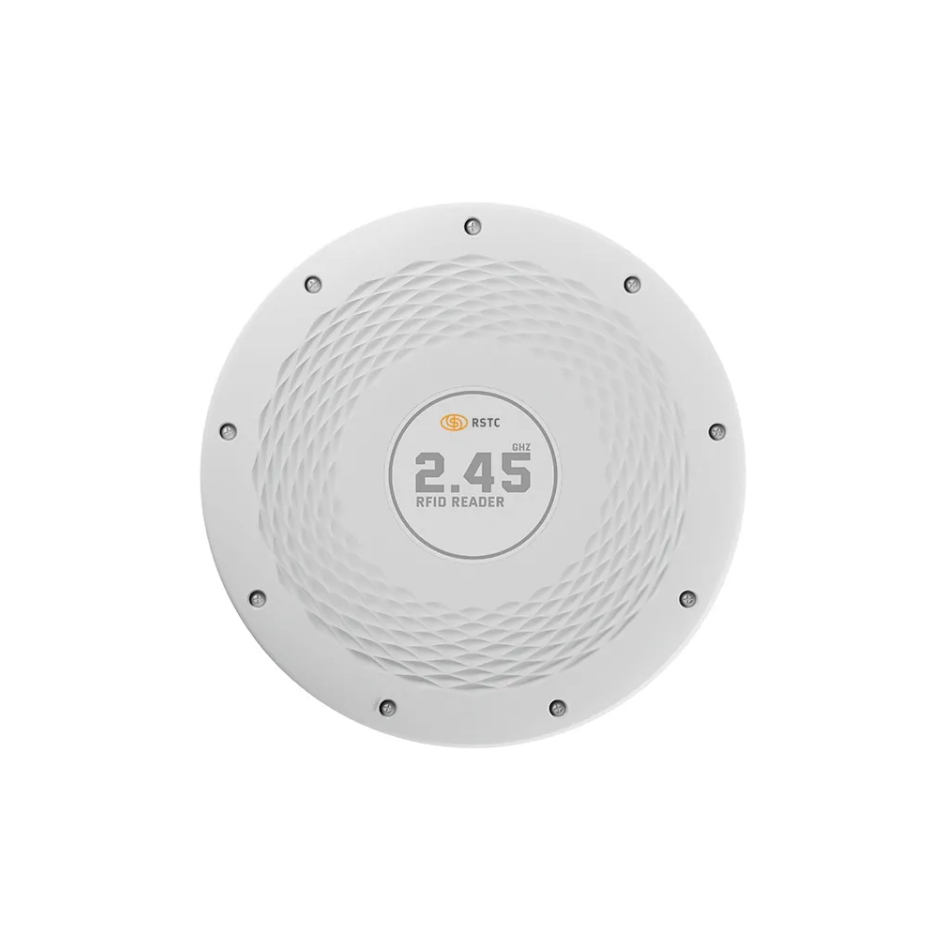
The RS-AI01 Fixed 2.45GHz Active Circle Outdoor RFID Reader is one option for these applications. It uses a fixed 2.45GHz active RFID design and supports omni-directional, long-range tag identification. Its software-adjustable reading distance ranges from 0 to 120 meters, depending on tag output power and deployment requirements.
The device can identify up to 300 tag IDs per second and process up to 300 tags simultaneously. It supports RS-232 and 10/100M Ethernet, with optional RS-485, Wiegand 26/34, and customized interfaces. Its IP67-rated enclosure supports deployment in suitable indoor and outdoor environments.
Build the Integration Around Existing Systems
For manufacturers upgrading established production lines, compatibility with current equipment can affect project cost and implementation time. Before purchasing hardware, the engineering team should review controller interfaces, network architecture, software requirements, and available installation space. A staged deployment can reduce disruption to ongoing production.
RSTC supplies RFID hardware and related industrial IoT solutions. Its product range includes readers and other identification equipment for applications such as logistics, industrial automation, and asset management. Buyers evaluating a reader should confirm its interface options, tag compatibility, and environmental suitability against the requirements of their own installation.
System integration should also account for fault handling. If a reader disconnects or a network becomes unavailable, the application needs a defined response. Depending on the system design, this may involve logging the fault, retrying communication, or notifying maintenance staff. Clear procedures help teams distinguish hardware issues from software or network problems.
Prepare for Maintenance and Future Expansion
Production requirements often change as new workstations, product variants, or material routes are introduced. Engineers should document reader locations, communication settings, tag configurations, and software dependencies. This information makes troubleshooting easier and provides a practical reference when expanding the line.
Maintenance teams should periodically inspect mounting points, cables, connectors, and enclosure condition. They should also review identification logs for recurring missed reads or unexpected events. Changes to machinery layouts or nearby radio equipment may justify another performance test.
When a project requires additional identification points, the original system design should make it possible to add readers without unnecessarily restructuring the entire network. Buyers considering industrial RFID readers should therefore assess both current production needs and likely changes in material flow.
Turn Identification Data into Production Value
Seamless integration begins with a clear workflow, suitable hardware placement, compatible communication interfaces, and testing under real operating conditions. These steps help manufacturers collect useful identification data while reducing unnecessary manual work. Reader performance should be evaluated against defined production requirements rather than specifications alone.
For businesses planning an automated identification project, RSTC provides RFID hardware options that can be assessed according to application needs. Comparing RFID Readers by reading range, processing capacity, interfaces, and environmental protection can help engineering teams develop an integration plan that fits their production environment.
