At anchor, cool air competes directly with navigation electronics, refrigeration, lighting and every other load supported by the house battery. There may be no steady shore supply, and the next opportunity to recharge can depend on sunlight, generator use or a change in cruising plans.
Air conditioning is therefore an energy-management problem before it becomes an equipment-selection problem. An overnight runtime estimate has to come from the vessel’s energy ledger rather than the unit’s cooling label.
Calculate Energy, Not Just Battery Capacity
Battery capacity is often discussed in amp-hours, but the cooling budget is easier to compare in watt-hours. Multiplying usable battery amp-hours by the relevant system voltage provides an approximate usable energy figure; battery operating limits and other losses still need consideration.
On that basis, sailboat air conditioning cannot be assigned a credible overnight runtime from nominal bank capacity alone, especially when other equipment draws from the same supply.
For illustration, a machine drawing 840 W continuously for four hours would consume 3.36 kWh over that period. The calculation is a fixed-power example, not a four-hour runtime prediction for a variable-speed marine system.
Real draw changes with cabin load, compressor control and operating mode. A plan based on rated input is useful for checking the scale of demand, provided the crew distinguishes a calculation assumption from measured consumption.
Account for the Equipment Beyond the Compressor
A seawater-cooled marine unit requires heat to move through two circuits: cabin air across the evaporator and water through the condenser. A seawater pump and any separately installed distribution equipment can create additional electrical loads. Their own specifications belong in the energy ledger rather than being silently assumed to be covered by the refrigeration unit’s published rating.
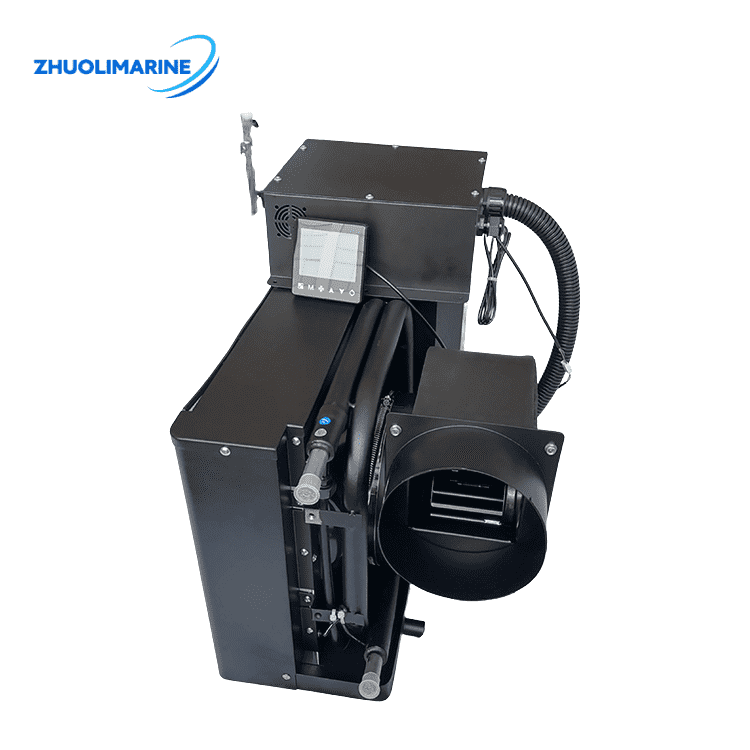
Electrical planning becomes more concrete with the self-contained MAR-12V/12BP from ZhuoliMarine: the 12V DC model specifies 840 W rated input, 70 A rated current and 900 W maximum input alongside 12,000 BTU cooling and 12,250 BTU heating capacity.
Its seawater-flow specification is 1,080 L/h, while the cabin airflow figure is 550 m³/h. Pump consumption must be added separately, and battery endurance still depends on usable stored energy plus the other loads running aboard.
Treat Charging as a Daily Balance
Solar output arrives unevenly, while the strongest cooling demand may occur during hot afternoons or persist after sunset. Battery charging has to replace not only the cooling energy consumed, but also the electricity used by the vessel’s other systems.
Cloud cover, panel orientation, usable battery capacity and charger limits can change the balance substantially between two apparently similar days. Daily energy estimates should therefore compare a conservative charging scenario with the expected cooling period, not treat the solar array’s peak output as continuous production.
A smaller cabin may call for less installed cooling capacity. On the 12V MAR-12V/09BP, 9,000 BTU cooling is paired with a 55 A rated current and 660 W rated input; its specified maximum draw is 720 W.
Both that model and the 12,000 BTU example operate on 12V DC, but their different power and cooling ratings prevent them from being treated as equivalent. Real suitability depends on the cabin heat load, not a preference for the lower wattage alone.
Reduce the Heat Entering the Cabin
Glazing exposed to direct sun, poorly shaded hatches and heat stored in deck structures can increase cooling demand long after the afternoon peak. Shade and appropriate ventilation before cooling begins may reduce the temperature the machine has to overcome. Once the cabin is being cooled, uncontrolled openings can introduce warm, humid air and increase the work needed to maintain comfort.
The climate, insulation and occupancy pattern are therefore part of sailboat air conditioning calculations. A heavily insulated berth used by one person may behave differently from a saloon occupied by several people after cooking. An oversized unit can also cycle in ways that complicate humidity removal.
Cooling capacity and battery investment deserve to be decided together only after realistic cabin conditions have been recorded. A useful record includes hours of direct sunlight, the night-time ventilation pattern and which cabins remain closed while the crew is asleep.
Translate Specifications into Nights Aboard
An anchored vessel introduces practical limits that are easy to omit from a spreadsheet. Seawater circulation must remain available, hoses and electrical connections need safe routes, and air should reach the occupied berth without an uncomfortable direct draft.
The MAR-12V/12BP provides a 360-degree adjustable blower, a replaceable air filter and published noise figures of 42/52 dB; installed sound can vary with the surrounding structure.
ZhuoliMarine also specifies inverter compressor control, an electronic expansion valve and app-based Wi-Fi adjustment for the 12V Yacht unit. These features support operating control, but do not justify a fixed percentage of energy savings or a guaranteed number of quiet overnight hours. A complete sailboat air conditioning assessment compares anticipated use with available energy and confirms the required seawater and air paths before installation.
A practical anchorage plan is built around available energy, not a promised runtime. Rated power and current in ZhuoliMarine‘s DC marine model specifications provide inputs for the calculation; its installation guidance and remote technical support address connection and routing details that the energy worksheet alone cannot settle.
Planning extended nights at anchor requires an onboard energy worksheet based on the chosen model’s electrical ratings, pump requirements and realistic charging conditions.
