A wide shell that is easy to bend can be difficult to support, while a shorter, thicker component may demand greater forming force within a smaller working space. Heavy fabrication brings these constraints together rather than presenting one maximum thickness to solve.
A plate rolling machine consequently has to suit both the component and its route through the factory. Customization becomes useful where material behavior, finished geometry or handling requirements create a combination that a standard arrangement does not adequately address.
The Component Sets More Than a Thickness Limit
Material strength changes the load required to develop permanent curvature. Two plates of equal thickness can therefore place different demands on a CNC rolling machine, especially when their widths or required diameters also differ.
Specifying the material condition alongside those dimensions defines the forming task more completely than quoting thickness alone. The relevant capacity belongs to that combination of workpiece properties and geometry.
Plate-end preparation adds a separate requirement. Rolling the main length develops curvature where the plate is supported through the rolls, whereas pre-bending addresses the ends under different contact conditions.
A shell that needs controlled curvature close to its joining edges may consequently make pre-bending capacity decisive. A maximum rolling thickness cannot simply replace the corresponding end-forming limit in the job definition.
Finished diameter and the shape of the component also influence the proposed arrangement. A cylindrical shell and a tapered section require different relationships between the plate and the forming elements.
The required form identifies what movements and support are needed, including how the part changes during processing. These dependencies explain why an industrial application cannot be represented by material thickness and width alone.
Structure and Support Respond to Different Demands
Roll arrangement determines how the plate is held and bent through the forming sequence. A CNC rolling machine with four rolls can use lower-roll clamping together with side-roll movement, assigning holding and curvature development different functions.
Three-roll arrangements organize contact differently. Choosing a structure is therefore a response to the required operations and workpiece behavior, rather than a ranking based solely on roll count.
Large workpieces also carry their own weight as their shape develops. An unsupported region can move away from the intended position, complicating feeding or altering the form presented to the rolls.
Support for a plate rolling machine must carry the flat blank as it enters the rolls and follow the workpiece as it curves. On a wide shell, the useful contact point changes as the free end rises, so the support must reach the part without obstructing its travel.
Support and clamping are related but distinct. Clamping controls contact with the driven forming elements, while an auxiliary support carries a region extending away from them.
Increasing clamping action does not automatically support a large projecting shell. A configuration can consequently require both a suitable grip at the rolls and a separate means of carrying the developing component through its intended movement.
The Factory Layout Becomes Part of the Solution
The space occupied by a CNC rolling machine is only part of its operating envelope. Flat plate needs an approach route, curved work changes the occupied space, and the finished component needs an exit. A nominally suitable machine can still create an awkward operation if a column, aisle or adjoining station obstructs one of those movements. Layout decisions follow the workpiece throughout the cycle.
An interface specification gives Colgar’s OEM/ODM rolling support something concrete to address: where material arrives, how it is supported and where the completed form leaves.
Feed direction, available transfer space and the required unloading route describe engineering requirements rather than a general request for a larger machine. They also establish which movements belong to the rolling station and which depend on surrounding handling equipment, including any required lifting or turning.
The next operation can change those requirements. A shell moving directly toward a joining station may need a different transfer arrangement from one placed in intermediate storage.
Its orientation after unloading affects the next lift or repositioning task, even though the required rolled diameter remains unchanged. A customized installation gains practical value by accommodating that handoff instead of optimizing the isolated forming movement while leaving the surrounding route unresolved.
Judging the Arrangement Through the Intended Work
A plate rolling machine proposal becomes specific when capacity conditions and handling requirements refer to the same job. In Colgar’s W12NC20×2500 table, a width of 2500mm and a material yield condition of 245MPa accompany a maximum rolling thickness of 20mm and maximum pre-bending thickness of 16mm. The figures describe different tasks, so the larger value cannot be transferred to plate-end preparation.
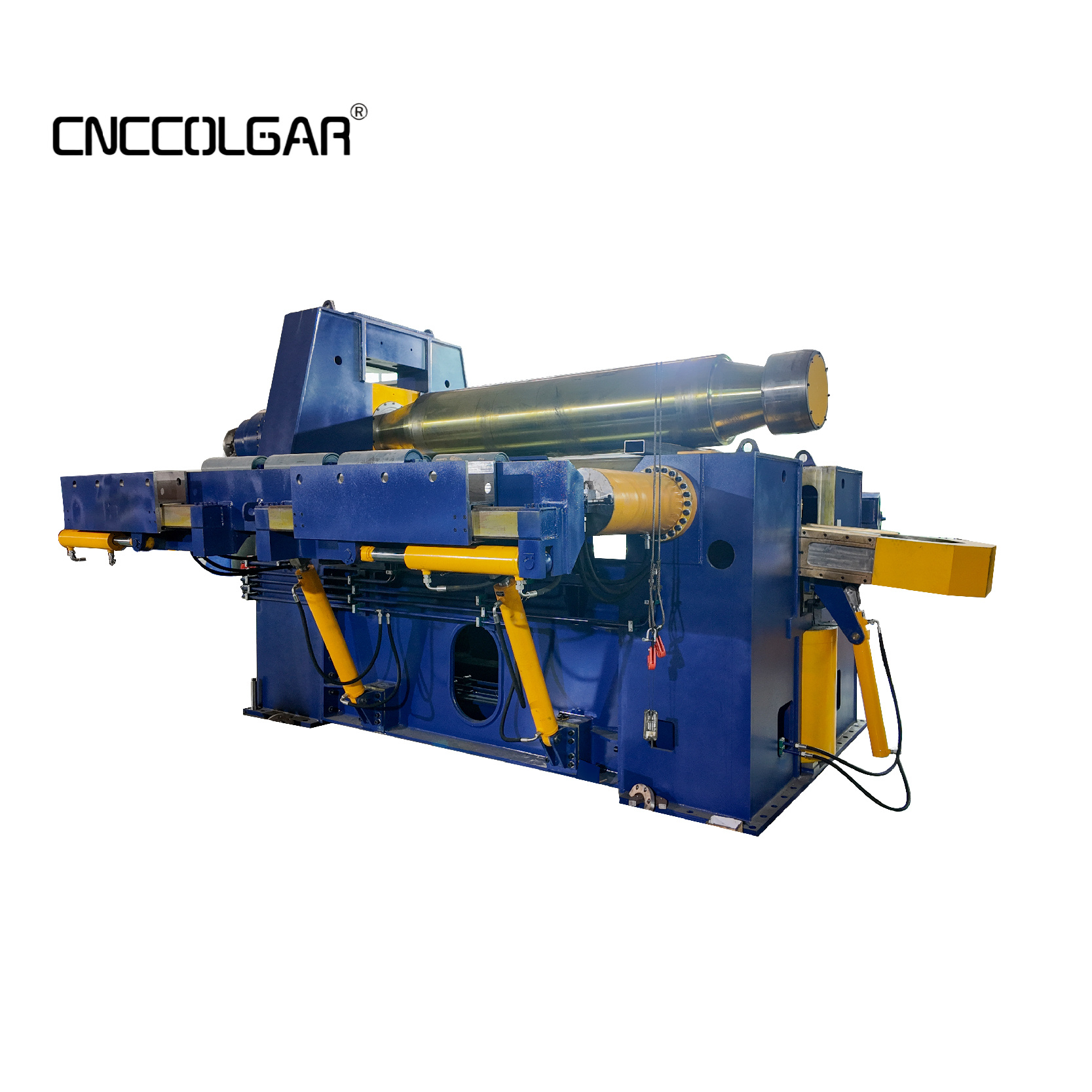
In the related W12 design, the internal plate support carries the workpiece during forming, and the hydraulic tipping device opens the roll end for unloading. The plant needs sufficient unloading clearance and a stable receiving support that can take the shell’s weight as it leaves the upper roll.
Customization for Colgar‘s rolling equipment is meaningful when the chosen arrangement resolves the constraints that prompted it. A representative component can expose whether support remains available as curvature develops and whether the completed form can reach its next operation. The reason for customization is the fit between a particular heavy component and the movements its factory can accommodate, rather than an additional collection of features.
