Reliable curing is essential to electronics manufacturing because coating performance affects insulation, moisture resistance, and long-term component reliability. Effective UV curing solutions depend on matching the curing method to the material, controlling exposure conditions, and validating results under actual production conditions. Consistent UV curing depends on matching the light source to the coating chemistry, controlling exposure conditions, and verifying performance under representative production conditions.
How to Match the Curing Method to the Coating Chemistry?
Conformal coatings protect printed circuit boards from humidity, dust, chemical exposure, and other environmental stresses. However, formulations respond differently to ultraviolet wavelengths, so the curing method must align with the coating manufacturer’s specifications. A mismatch can leave material partially cured, even if the surface appears dry.
Before production begins, manufacturers should review the coating’s spectral sensitivity, recommended exposure range, and substrate compatibility. Material data sheets provide a useful starting point, while trials on representative assemblies reveal how component geometry and coating thickness affect the result.
Process validation should also account for shadowed areas beneath connectors, tall components, and closely spaced parts. UV light may not reach every surface equally, making it important to assess whether secondary curing or a different coating formulation is necessary for difficult geometries.
| Coating type | Curing consideration | Process check |
| UV-curable conformal coating | Spectral match and irradiance | Cure depth and surface tack |
| Shadowed areas | Light access limitation | Secondary cure or coating review |
How to Control Light Exposure and Thermal Conditions?
Curing quality depends on more than exposure duration. Irradiance, wavelength, distance from the light source, coating thickness, and conveyor speed all influence the energy delivered to the material. Manufacturers should establish a repeatable operating window instead of relying on a single timer setting.
Although UV LED curing systems can offer precise wavelength control and reduced heat transfer to the surrounding environment, their suitability depends on the chemistry being processed. Conventional UV lamps and LED sources have different spectral outputs, so a formulation designed for one source may not respond adequately to another.
Temperature also deserves attention when processing heat-sensitive electronic assemblies. Excessive heat can affect plastics, connectors, solder joints, and other vulnerable components. Monitoring representative boards during trials helps identify thermal limits before a process is released for routine production.
Recording temperature profiles across the board surface during those trials also supports more informed decisions about light intensity, exposure time, and any necessary cooling measures.
How to Build Repeatability Into the Production Line?
A curing process should remain stable across shifts, operators, and product batches. Documented settings for lamp output, conveyor speed, working distance, and exposure time help reduce variation when production changes or equipment is serviced.
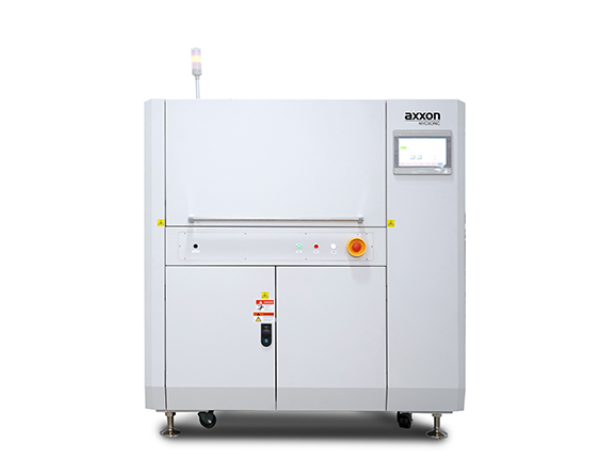
Equipment configuration can influence both throughput and process consistency. The AUV150 UV curing oven from Axxonauto Mycronic is a compact inline system designed for conformal coating materials. Its microwave-powered lamps and custom-designed high-gloss aluminium reflectors focus high-energy UV light onto the substrate, while the system can cure across the UV spectrum within a footprint of approximately 1,500 mm. These features support shorter curing times, although actual results depend on coating chemistry, board design, and validated process settings.
Maintenance records are equally important. Lamp output may change with operating age, reflectors can accumulate contamination, and conveyor mechanisms may drift from their intended settings. Scheduled inspections, equipment logs, and reference samples help manufacturers detect changes before they create widespread quality issues. Maintenance records should also be linked to production data, so that changes in cure quality can be traced back to lamp age, reflector condition, or conveyor drift before they affect a larger batch.
Conclusion
Strong curing performance comes from a controlled relationship between material selection, light delivery, thermal management, and verification. Manufacturers should define acceptance criteria before ramping up production, then test representative assemblies under realistic operating conditions.
Periodic checks can confirm that the process remains within its validated range as products and production demands evolve. With suitable process controls and equipment matched to the application, Axxonauto can be considered as part of a broader strategy for dependable electronics coating operations.
FAQs
What Causes Incomplete UV Curing on Circuit Boards?
Check irradiance at the work surface, verify that the source wavelength matches the coating specification, and inspect shadowed areas for incomplete curing. If the problem persists, review coating thickness and exposure settings through controlled trials.
How Can Manufacturers Verify Curing Quality?
Depending on the coating, verification may involve hardness checks, adhesion testing, solvent resistance tests, or other methods specified by the material supplier. Testing should reflect the assembly’s intended operating environment.
Are UV LED Curing Systems Suitable for Every Conformal Coating?
No. Compatibility depends on the coating’s photoinitiator chemistry and spectral response. The formulation supplier should confirm whether the selected light source can achieve the required cure under the intended process conditions.
What Should Be Recorded During Process Validation?
Important records include coating batch, exposure settings, lamp output, conveyor speed, ambient and component temperatures, test results, and any process adjustments. These details make deviations easier to investigate and reproduce.
